1089: The Magical Math Trick That Will Blow Your Mind
You lean forward, intrigued. He starts explaining a trick so simple yet so extraordinary, that you’ll think about it long after the curtains fall. Welcome to the magic of 1089.
All you need is a pen, some paper, and an open mind. Let’s begin.
You Are the Star
- Think of a three-digit number, where the first digit is larger than the last (e.g., 531 or 862).
- Now, reverse the digits of your number.
- For example, 531 becomes 135.
3. Subtract the smaller number from the larger.
- 531 − 135 = 396
Have you done it? Great. Now let’s go further.
The Transformation: Where the Magic Happens
- Take the result from your subtraction and reverse it again.
- In our example: 396 becomes 693.
2. Add this new reversed number to the original result.
- 396 + 693 = 1089
No matter what number you started with, the answer is always the same: 1089.
Isn’t that incredible? You’ve just experienced a moment of mathematical magic, and the secret is hidden within the beauty of numbers.
The Big Reveal: How It Works
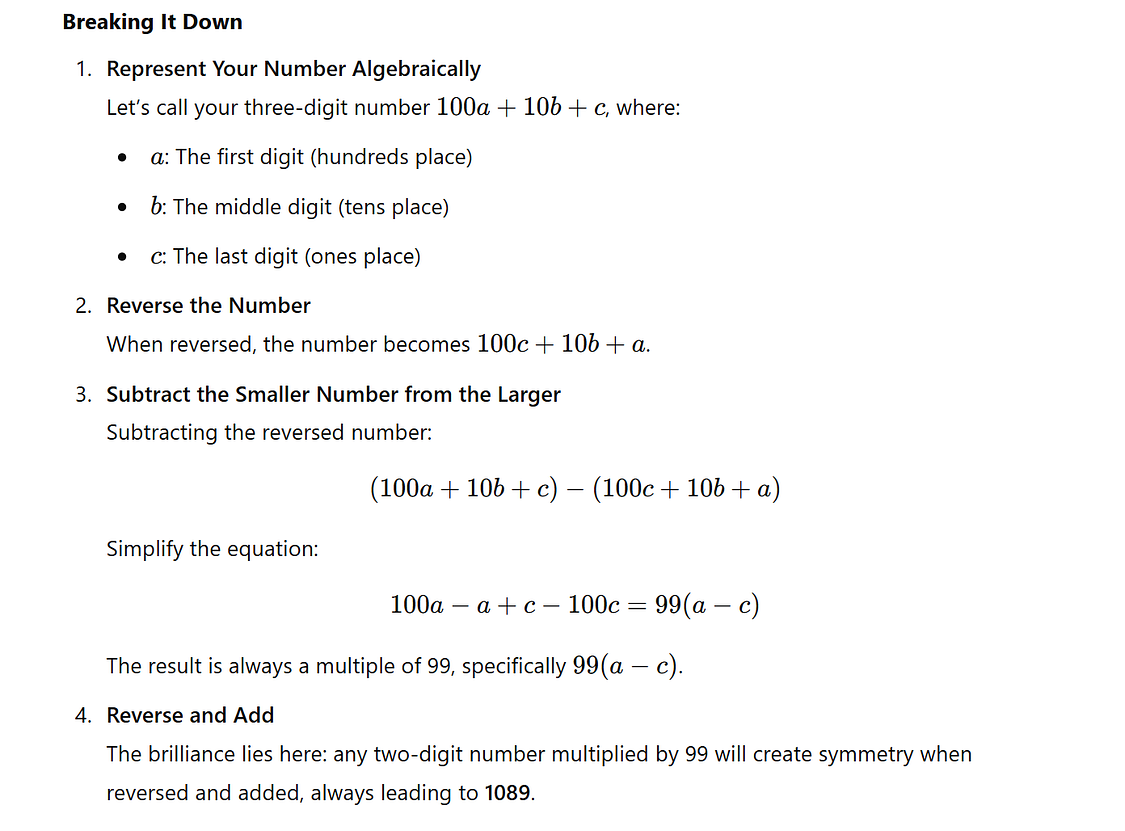
Now that we’ve had our “ta-da” moment, let’s peek behind the curtain. Why does this trick always lead to 1089?
Mathematically, the secret lies in the properties of three-digit numbers and how the subtraction aligns certain numerical patterns.
My First Encounter with 1089
The first time I came across this trick, it felt like I was seeing a magician’s secret up close. Numbers don’t usually behave this way — or so I thought. I remember trying it on scraps of paper, over and over, half-expecting the spell to break. But it didn’t.
I tried it with my younger cousin. As I guided them through the steps, I saw their eyes light up when we reached 1089, like they’d just witnessed something out of this world. That’s when I realized: that math has its own magic.
Why It Matters: The Joy of Discovery
At first glance, this seems like a neat party trick. But there’s a deeper lesson here. Math isn’t about memorizing equations or solving problems for grades — it’s about exploring patterns, discovering connections, and unlocking mysteries.
In a world where math often feels like work, tricks like the Coincidence of 1089 remind us that math can also be played.
Try it
Next time you’re with friends or family, try this trick. Walk them through the steps. Watch as their eyes widen when the final number appears. And then, let them in on the secret.
Because here’s the truth: magic isn’t about keeping people in the dark. It’s about sharing the light of wonder and discovery.
Let’s keep the magic alive. Share this with someone who loves a good mystery — or better yet, show it to someone who doesn’t. You just might change how they see math forever.


Comments