Everyone loves to celebrate success — the groundbreaking inventions, the rags-to-riches triumphs — but what about the failures?
In a world obsessed with instant results and quick fixes, the “how” often overshadows the “why” and “what went wrong.” Yet the truth is, the journey — with all its failures, missteps, and struggles — is what shapes us. It’s what gives success its meaning.
Failure isn’t the opposite of success; it’s part of it. It’s a messy, uncomfortable part that teaches us more than any victory ever could. These failures, these missteps — these dreams that didn’t quite take off — have just as much to teach us as the triumphs.
Failure, when examined with honesty and curiosity, is more than just a setback. It’s an unfiltered look at ambition, risk, and creativity. And in the cracks of those failures, we find lessons that no victory can teach.
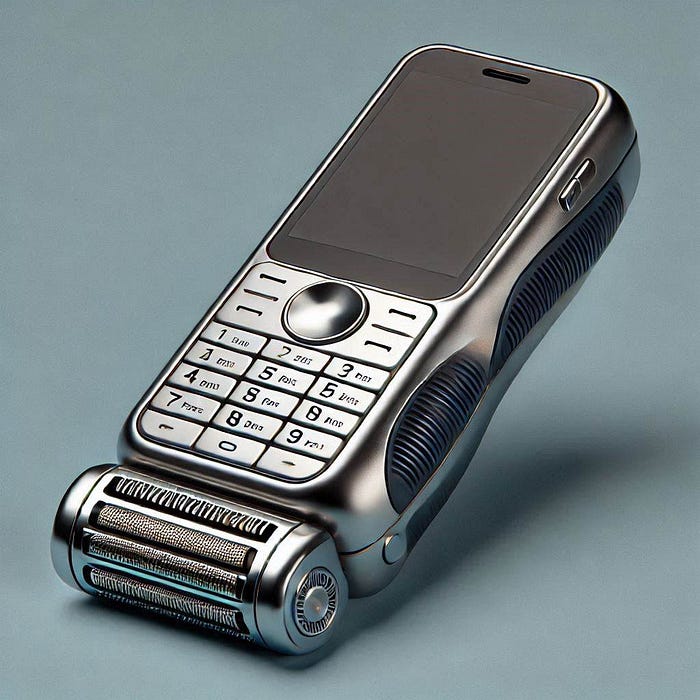
A Razor Phone: Shave and Talk, Anyone?
It’s 2009. Somewhere in a boardroom, a group of designers is beaming with pride. They’ve done it, they think — a multitasking marvel: a phone that doubles as an electric shaver. The Tondemoketai Razor Phone is their love letter to innovation.
But love can be blind. Consumers aren’t interested in holding a buzzing razor to their faces during calls. The Razor Phone doesn’t just flop — it vanishes, taking the team’s optimism with it.
Now imagine that pitch meeting. The team believes they’ve solved a problem nobody even knew they had. They’re dreaming of convenience, of headlines calling them trailblazers. What they miss is this: boldness without practicality is just a gimmick.
The lesson? Solve a real problem. If you don’t, your dream won’t just fail — it’ll disappear.
It’s 1939. RCA unveils its next big thing: the radio newspaper. A world where news can travel faster than ever, transmitted by radio signals and printed on long rolls of paper right at home.
The room buzzes with excitement. The inventors see themselves as pioneers, leaving traditional media in the dust. But their vision is blurry. The technology isn’t there yet, and the clunky, cumbersome paper rolls make the whole concept more hassle than help.
Even if the tech had worked, would people have cared? Sometimes failure isn’t about timing — it’s about asking the wrong question. The radio newspaper didn’t ask: “What do people want?” It assumed the answer, and that was its undoing.
Bold ideas are great. But bold ideas without an audience? Those are just fantasies.
Look at the monowheel — a sleek, minimalist promise to revolutionize personal transport. One wheel, one rider, infinite possibilities. But here’s the catch: it’s nearly impossible to balance. It’s awkward. It’s impractical.
Picture the workshop: a chalkboard covered in sketches, prototypes glimmering under dim lights. You can see the inventor’s hope, the belief that they’re building the future. And they are — in a way. Because even though the monowheel flops, its DNA lives on in hoverboards, electric scooters, and other modern alternatives.
The monowheel’s problem wasn’t just its flaws — it was its failure to adapt. Progress rarely comes in a single leap. It’s the result of small, iterative steps, each building on the lessons of the last.
Nintendo’s Virtual Boy: A Headset That Fell Flat
In 1995, Nintendo launched the Virtual Boy, a portable gaming console that promised immersive 3D gameplay. It sounded like the future. Instead, it became a cautionary tale.
The headset was heavy, the graphics painful on the eyes, and the market wasn’t ready for virtual reality. What started as a bold leap ended as a painful stumble.
But here’s the twist: the Virtual Boy wasn’t a failure — it was a seed. Without it, today’s VR headsets wouldn’t exist. Oculus, PlayStation VR, and others owe part of their success to Nintendo’s misstep.
Sometimes failure isn’t about the present; it’s about the foundation it lays for the future.
Modular Phones: Too Much, Too Soon
Over a decade ago, modular phones promised to change the world. Imagine swapping out your phone’s camera, upgrading its processor, or replacing its battery — all without buying a new device.
It could have been revolutionary. But the dream died. Why? Because the market didn’t want complexity. Consumers chose simplicity over sustainability. And without standardization, the modular phone was doomed.
If it had succeeded, we might have reduced e-waste and redefined smartphone design. But success isn’t about what could be. It’s about what people are ready for. Sometimes, they aren’t ready for something better — they just want something easier.
The Cat Translator: A Meow Ahead of Its Time
In 2003, Takara Co. introduced “Meowlingual,” a device that claimed to translate cats’ meows into human phrases. It was bizarre, endearing, and ultimately a failure.
But here’s the thing: people never stopped dreaming about it. Years later, apps inspired by Meowlingual found their moment. The line between novelty and innovation is razor-thin, and this quirky invention proves it.
Even the oddest ideas can have staying power if they tap into something universal. People love their pets. They always will. Sometimes, even a failure can leave behind a spark that refuses to die.
Failure Isn’t Final
Success is seductive. It’s shiny, easy to celebrate, and easy to sell. But failure? Failure is where the real stories are.
Behind every Razor Phone or Virtual Boy is a team of dreamers who risked everything — and lost. But that loss wasn’t meaningless. It taught them resilience, forced them to adapt, and planted seeds for future breakthroughs.
Not every failure leads to success. Some ideas are better left unrealized. The Razor Phone didn’t pave the way for better gadgets. The radio newspaper didn’t inspire modern media. But their stories still matter. They remind us that ambition has limits and that asking the hard questions — “Is this what people really need?” — is the only way to succeed.
As Steve Jobs once said, “You’ve got to start with the customer experience and work back toward the technology.” Many of these inventions lacked the customer focus or practical application to succeed in their era. But their failures aren’t wasted; they’ve inspired new generations of innovation.
As Thomas Edison once said, “I have not failed. I’ve just found 10,000 ways that won’t work.” Maybe the better lesson is this: some ideas won’t work, and that’s okay. Even dead dreams leave footprints.
The Beauty of Failure
Failures aren’t just roadblocks; they’re stepping stones. Every failed invention tells a story of ambition, risk, and creativity. Those stories deserve to be told — not just to honor the inventors, but to inspire the dreamers of tomorrow.
The next time you see a “failed” product, look closer. It’s not just a mistake — it’s a mirror. It reflects our boldness, our flaws, and our potential. And sometimes, if you look closely enough, you’ll see the future staring back at you.
We all have got the bones of something compelling, but we’re playing it too safe. We should Take risks. Be bolder. Fail harder.
So, the next time you scroll through your news app or upgrade your smartphone, spare a thought for the dreamers and inventors who dared to think differently, even if the world wasn’t ready for them. Innovation isn’t just about success; it is about the courage to fail.
It begins with the clink of ice against glass. A sharp bitterness gives way to sweetness, and suddenly, you’re not just drinking — you’re part of a history that spans centuries and continents. The Gin and Tonic isn’t just a cocktail; it symbolises ingenuity, resilience, and indulgence, born from necessity and elevated to an art form. A Malaria Cure in a Glass It’s the mid-19th century, and the British Empire is sweltering under the tropical sun of India. Soldiers and officials face an invisible enemy far deadlier than any opposing army: malaria. The culprit? The Plasmodium parasite, carried by mosquitoes, causing fever, chills, and sometimes death. Enter quinine, extracted from the bark of the cinchona tree. Known for centuries by indigenous Quechua people of South America as a remedy for shivers, quinine was a scientific marvel of its time. Scottish doctor George Cleghorn documented its effectiveness against malaria in the 1700s, making it indispensable for colonial t...
What started as a simple pub argument evolved into a global cultural and commercial empire. The story of Guinness World Records is a fascinating blend of innovation, marketing genius, and unexpected success. Today, it’s not just about setting records — it’s a celebration of human achievement, from extraordinary feats to bizarre accomplishments. The Pub Argument that Launched a Global Legacy In 1951, Sir Hugh Beaver , managing director of Guinness Breweries , found himself in a heated debate during a hunting party in Ireland. The conversation turned to the question: Which is the fastest game bird in Europe? Some argued it was the golden plover ; others insisted it was the red grouse . However, no one could settle the dispute, and there was no authoritative source to answer it. This unresolved argument stayed with Beaver, and he saw an opportunity — a book to settle these types of debates could be a great addition to the pub experience. He realized that by linking it to the Guinne...
Japan’s expertise in earthquake-resistant architecture blends ancient wisdom with cutting-edge technology. Living in one of the world’s most seismically active regions, the Japanese adapted their buildings to withstand frequent, powerful earthquakes. This journey reflects centuries of experience and innovation, from wooden pagodas to skyscrapers. Why Earthquake-Resilient Design is Critical Located along the Pacific Ring of Fire , Japan faces thousands of tremors every year. Major earthquakes, like the Great Kanto Earthquake (1923) and the Tohoku Earthquake (2011) , cause widespread destruction. To protect lives and property, earthquake-resistant architecture became a national priority. “Move with the Earth”: The Philosophy Behind Japanese Architecture Japanese buildings embrace movement rather than resisting it. The saying, “shiku wa tate, tate wa shiku” (the ground is the foundation, the foundation is the ground), emphasizes harmony between st...
Imagine you’re sitting in a dimly lit theatre. A magician exudes confidence onto the stage, holding nothing but a simple deck of cards and a marker. He looks straight at you and says, “Prepare to witness magic, not with cards, but with numbers. This is no illusion — it’s the undeniable power of mathematics.” You lean forward, intrigued. He starts explaining a trick so simple yet so extraordinary, that you’ll think about it long after the curtains fall. Welcome to the magic of 1089 . All you need is a pen, some paper, and an open mind. Let’s begin. You Are the Star Think of a three-digit number , where the first digit is larger than the last (e.g., 531 or 862). Now, reverse the digits of your number. For example, 531 becomes 135. 3. Subtract the smaller number from the larger. 531 − 135 = 396 Have you done it? Great. Now let’s go further. The Transformation: Where the Magic Happens Take the result from your subtraction and...
Everyone has heard of LG, we know it is a worldwide household products company. However, what most of us don’t know is that LG started as a Makeup Cream later expanding to soap, hairbrushes, toothbrushes, and washbowls. The company started as a humble beginning with a name called Lucky Chemical Co., Ltd. during post-war Korea. From Lucky Cream to a Lucky Break In 1947 in South Korea after the devastating effects of World War II, a small company called Lucky Chemical Co., Ltd. was born among the entrepreneurial endeavours. The company was named “Lucky,” which sounded like the Korean phrase Lak Hui, which means “giving joy to all.” Their first product was a makeup cream aptly named “Lucky”. https://cdn-images-1.medium.com/max/800/1*HeiLKRrEPpGnv802buOBRw.png The odds were tough. The country was struggling economically, and this cream wasn’t cheap. But its quality won people over, and it quickly became a success. Still, things didn’t go smoothly. Customers began returning the cream — not ...
Sony Corporation, one of the world’s most recognizable and influential companies, boasts a history as fascinating as its groundbreaking innovations. From humble beginnings in war-torn Tokyo to becoming a global conglomerate, Sony’s story is one of resilience, creativity, and an unrelenting drive to push boundaries. The Seeds of Innovation: War-Torn Tokyo and a Bold Vision The year was 1945, and Japan was grappling with the aftermath of World War II. Amid the chaos, Masaru Ibuka, a defence contractor, arrived in a ravaged Tokyo with a dream. On the third floor of the dilapidated Shirokiya Department Store, he established “Tokyo Tsushin Kenkyujo” (Tokyo Telecommunications Research Institute), fondly abbreviated as Totsuken. This small company would later become the foundation of Sony Corporation. Initially, the company focused on repairing radios, a vital service in a country rebuilding its communication networks. However, Ibuka’s aspirations stretched far beyond repairs. The company’s f...
The story of Mary Celeste is one of the most enduring and captivating mysteries in maritime history. An abandoned ship discovered adrift in the Atlantic Ocean in December 1872 has puzzled investigators, writers, and historians for more than a century. With no definitive explanation, the tale weaves through a complex tapestry of tragedy, speculation, and intrigue, raising questions about human nature, the unpredictability of the sea, and the limits of our understanding. Setting Sail: The Voyage of the Mary Celeste https://cdn.pixabay.com/photo/2013/07/12/13/25/galleon-146994_1280.png The Mary Celeste began her ill-fated journey on November 7, 1872. Commanded by Captain Benjamin Spooner Briggs, a respected mariner with an impeccable record, the ship departed New York Harbor bound for Genoa, Italy. Alongside Captain Briggs were his wife, Sarah, and their two-year-old daughter, Sophia. The remaining crew comprised seven sailors, all vetted and experienced. The ship carrie...
Have you ever stopped to ponder why we are so captivated by the weather? What is it about the impending rain, the gathering clouds, and the fluctuating temperature that draws our attention like a magnet? The weather is a phenomenon that touches every facet of our lives, from our clothing choices to our travel plans, and even our emotional states. In this exploration, we delve deep into the intriguing world of meteorology, unravelling its history, impact, and psychology behind our incessant weather-checking habits. The Weather’s Historical Reverence From ancient civilizations to modern societies, the weather has always held a unique place in human consciousness. Ancient cultures believed that weather patterns were governed by powerful deities, leading to the development of weather gods and rituals aimed at appeasing them. The unpredictability of the weather played a significant role in shaping the destinies of civilizations, from drought-induced famines to storm-driven conquests. ...
Innovation often emerges from adversity, and Ralph Teetor’s story exemplifies this truth. Blind from childhood due to a tragic accident, Teetor not only defied expectations but became a visionary whose invention — cruise control — transformed driving forever. A Childhood Accident That Sparked Resilience In 1890, Ralph Teetor was born in Hagerstown, Indiana, with normal vision. But at age five, a knife accident left him permanently blind. What could have been a life-altering limitation became the foundation of his resilience and ingenuity. Instead of succumbing to despair, Teetor developed an extraordinary sense of touch and mechanical intuition, which would define his career. Building an Automobile as a Teen: A Mechanical Prodigy Emerges While most kids tinkered with toys, Ralph was building a car. By his teenage years, he had constructed his own automobile — a feat few adults could match in the early 1900s. His exceptional talent for mechanics propelled him to pursue a degree in...
The Placebo Effect: How to Trick Your Brain Into Becoming Unstoppable The Strange Science Behind How Belief Can Heal, Hurt, and Transform You. We’ve heard that Mike Tyson is Iron Mike, David Goggins is the toughest man on Earth, and Muhammad Ali is The Greatest. But where did their power come from? What made them push, suffer, and rise tirelessly? It wasn’t divine. It wasn’t medicine. It wasn’t just emotion. It was their mindset . They used the power of the mind — what we now understand as the Placebo Effect . Want to be the best in your field? It’s time you understood how. What if the most powerful cure wasn’t something you could buy — But something you already had inside you? “We always thought power came from the outside — vitamins, cosmic rays, money, and medicine. But the truth? The greatest power’s always been inside your head. We live in a world ruled by logic, chemicals, and formulas. Yet one of the most extraordinary forces known to science is something...



Comments