Banana Sticker on SpaceX’s Starship: How Humor and Internet Culture Shaped Space Exploration
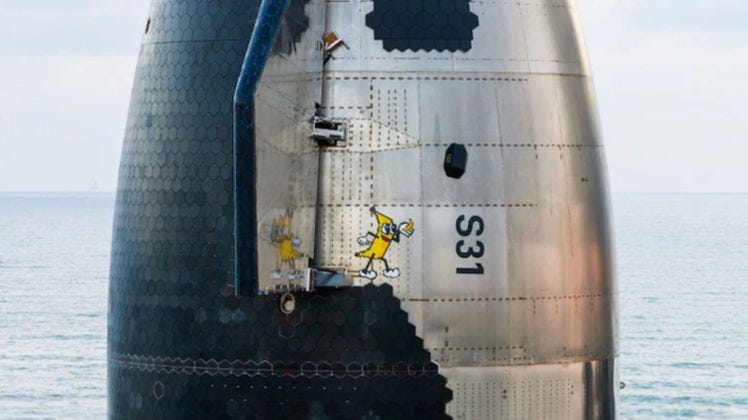
In the vast expanse of space exploration, where cutting-edge technology and scientific rigour often dominate the narrative, it’s not every day that humor slips into the mix. However, the sight of a small banana sticker on SpaceX’s Starship during one of its development phases brought a lighthearted moment into the otherwise high-stakes world of space travel. What might seem like a simple joke holds a deeper cultural resonance, one that ties together internet memes, human creativity, and the extraordinary challenge of exploring the cosmos.
Part I: The Origins of the “Banana for Scale” Meme
The “banana for scale” meme is rooted in the universal appeal of bananas as an instantly recognizable and approximately standard-sized object. The origins of this idea trace back to online forums like Reddit, where users in the early 2000s sought a humorous, practical way to illustrate the size of objects in photos.
Bananas, which are nearly ubiquitous and rarely vary in size to a noticeable degree, became the ideal visual reference point. The phrase “banana for scale” exploded into internet culture around 2013, following a viral Reddit post in which a user jokingly used a banana to measure the size of a sinkhole. The post attracted widespread attention, sparking countless imitations where bananas were juxtaposed with objects ranging from household items to enormous natural landmarks.
The meme captured the chaotic, irreverent humor of the internet age. But beyond that, it highlighted humanity’s innate need to make sense of scale — a concept deeply tied to our spatial awareness, curiosity, and ability to imagine dimensions far beyond our immediate surroundings.
Part II: Humor in the Scientific World
The banana sticker on SpaceX’s Starship didn’t emerge in a vacuum. Science and engineering, while serious fields have a long history of embracing humor to cope with challenges and connect with wider audiences.
Examples from History
- The Pioneer Plaques and Voyager Golden Records: Designed by Carl Sagan and his team, these plaques were sent into space aboard the Pioneer and Voyager spacecraft in the 1970s. They included illustrations and music intended for potential alien civilizations. While deeply symbolic, some scientists have joked about how aliens might misinterpret the images or find Earth’s disco music puzzling.
- Lego Figurines on Juno Mission: NASA’s Juno spacecraft carried three Lego figures depicting Galileo, Juno, and Jupiter as a whimsical nod to mythology and science.
- Rocket Names: Space agencies often use humor in naming their projects. For instance, SpaceX’s “Of Course I Still Love You” drone ship, used for landing rocket boosters, derives its name from a science fiction novel by Iain M. Banks.
The banana sticker is another example of scientists and engineers injecting levity into their work, acknowledging the profound absurdity of human endeavours like launching massive rockets into space.
Part III: The Banana Sticker’s Journey to Space
SpaceX’s Culture of Playfulness
SpaceX, under the leadership of Elon Musk, has cultivated a reputation for blending audacious technological ambition with a quirky, irreverent culture. Musk himself is known for embracing internet memes, as seen in his tweets and public statements. The banana sticker reflects this ethos — a lighthearted nod to internet culture amid SpaceX’s groundbreaking work.
The Starship Development Phase
The banana sticker first appeared on a prototype during one of the Starship’s assembly phases. As engineers worked tirelessly to refine the spacecraft — destined for missions to Mars and beyond — the sticker reminded onlookers of the human element behind these immense projects. It was a subtle way of saying, “We’re building something extraordinary, but we can still have fun.”
Public Reactions
When photos of the banana sticker surfaced online, they were met with delight. Social media erupted with discussions, memes, and jokes, reaffirming the enduring charm of the “banana for scale” trope. The sticker became an unlikely symbol of SpaceX’s ability to connect with a global audience, transcending the typical boundaries of scientific discourse.
Part IV: The Philosophy of Scale in Space Exploration
The banana sticker, as trivial as it might seem, touches on a profound concept in space exploration: the challenge of comprehending scale.
Understanding Celestial Distances
From Earth, even our closest neighbours in space seem incomprehensibly far away. For example:
- The Moon is 384,400 kilometres (238,855 miles) from Earth.
- Mars, on average, is 225 million kilometres (140 million miles) away. Bananas — or any relatable object — become a metaphor for making such distances tangible.
The Role of Play in Science
Humor and creativity often bridge the gap between complex scientific ideas and public understanding. The banana sticker encapsulates this principle, using a universal symbol of relatability to humanize one of humanity’s most ambitious projects.
Part V: A Historical Context for Humor and Symbolism in Exploration
Humanity’s history of exploration is peppered with symbols, jokes, and whimsical traditions:
- Sailing and Cartography: Early sailors often illustrated maps with mythical sea creatures, blending scientific mapping with storytelling.
- The Apollo 12 Prank: Astronauts on Apollo 12 smuggled a Playboy centrefold into their spacecraft as a lighthearted inside joke.
- Curiosity Rover’s Morse Code Tracks: NASA’s Curiosity rover on Mars has wheels that imprint Morse code spelling “JPL” (Jet Propulsion Laboratory) into the Martian soil.
The banana sticker on Starship fits seamlessly into this legacy, serving as a modern iteration of explorers’ timeless desire to leave personal, often humorous, marks on their monumental achievements.
Conclusion: More Than a Sticker
The banana sticker on SpaceX’s Starship is more than a funny internet reference. It represents the interplay of humor, human ingenuity, and the innate drive to explore. By blending the profound with the playful, the sticker reminds us that even as we reach for the stars, we remain grounded in the shared quirks of humanity.
As future generations look back on this era of space exploration, they may see the banana sticker as a small but poignant symbol of the creativity, humor, and relatability that accompanied humanity’s leap into the cosmos.


Comments